
Shortly before noon was the cheapest time to fill up in the national average of an ADAC analysis for May 2026. This offers a planning guide; the current prices at stations you can reach remain decisive.[2]
To save on everyday journeys, consider three things together: When does a fuel stop fit into your trip? Which station sells your chosen fuel for less? And how much would an extra journey to that station cost?
What changed in April 2026?
Germany’s Kraftstoffpreisanpassungsgesetz, the Fuel Price Adjustment Act, has applied since 1 April 2026. Public filling stations may increase petrol and diesel prices only once a day, at noon. Price reductions remain possible at any time.[1]
The rule does not set a uniform price per litre or require a station to raise its prices at noon. It restricts the timing of an increase. When planning a fuel stop you already need to make, it therefore makes sense to consider a time before noon and check prices beforehand.
Can you only fill up later? Compare the stations you can reach again. A cheaper provider along your route may be a better choice than making an extra journey solely for the timing.
How to compare petrol prices properly
You can use ADAC Drive or Clever-Tanken, for example, to search for prices. Germany’s Federal Cartel Office also publishes a list of consumer information services receiving price data from its Market Transparency Unit for Fuels.[4][5][6]
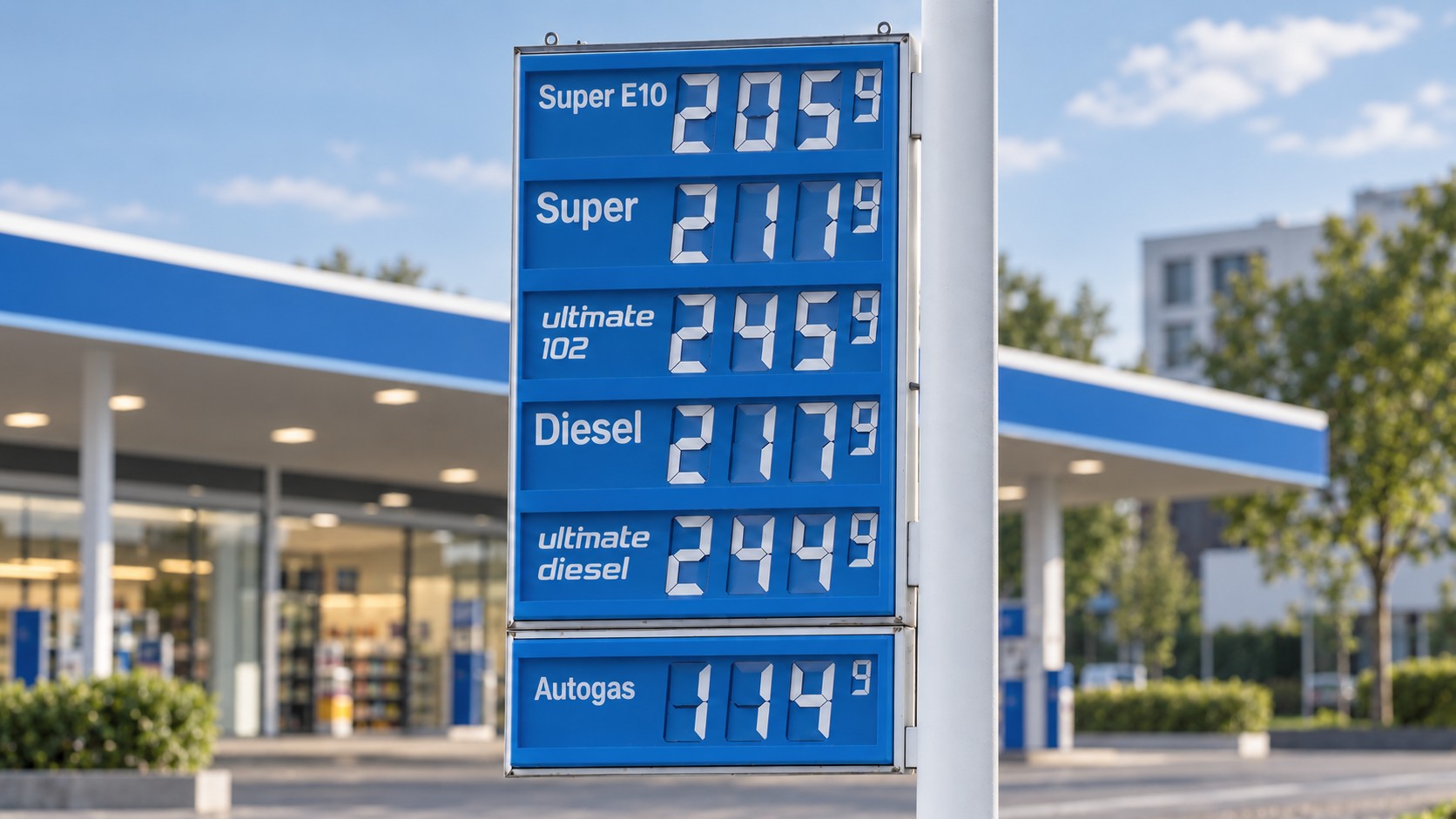
Start with your location or planned route, then select the exact fuel grade you intend to buy. An E10 price at one station and an E5 price at another are not a comparison of the same grade. Before switching fuels, check approval in your vehicle’s documentation; this price guide does not replace it.
Next, compare two or three stations that are convenient to reach. Check how current the display is, the opening hours and the driving distance. Check the price again before setting off and at the pump when you arrive. An earlier app display is not a price promise for later.
Is a cheaper filling station worth the detour?
First work out the saving for the amount you plan to buy: litres multiplied by the price difference per litre. Then deduct at least the extra fuel cost of the detour. A lower price per litre alone does not show whether the trip will cost less overall.
Here is a deliberately simple calculation using assumed values:
- Buying 50 litres at a price 5 cents lower saves €2.50 on the fill-up.
- A total of 10 extra kilometres, consumption of 7 litres per 100 kilometres and an assumed price of €2 per litre add €1.40 in fuel costs.
- That leaves €1.10 before accounting for time and other vehicle costs.
The 10 kilometres cover the entire extra distance, not just the outward journey. These are not current price or consumption figures. Buying less fuel reduces the benefit further. If the cheaper station is already on your route, that detour does not arise.
Check the location before a motorway trip
In ADAC’s comparison using price data from 6 to 19 April 2026, both Super E10 and diesel averaged around 33 cents per litre more at motorway filling stations than at stations on other roads. This describes the average at that time, not a fixed surcharge at every station.[3]
Before a longer journey, also compare a station before joining the motorway or near a suitable exit. Check the actual driving distance and opening hours. A station that looks close on a map may involve a longer detour by road.
Plan the stop with enough fuel in reserve. Do not wait until the tank is almost empty for a particular price or time of day.
A simple routine for your next fuel stop
Identify two suitable stations along a journey you already plan to make. Compare the same fuel grade shortly before leaving, calculate any detour and choose the station that works better overall. If your schedule is flexible, allow some time before noon for driving and any queue.
That turns the search for one perfect refuelling time into a practical decision: a suitable time, a checked price and a route that does not consume the saving.