
OBD-II Fault Code Decoder – Look Up Diagnostic Codes
Enter a code and read straight away what it means, which causes come into question and which symptoms go with it.
Enter a code, code prefix or term. Examples: P0420, P04 or catalyst.
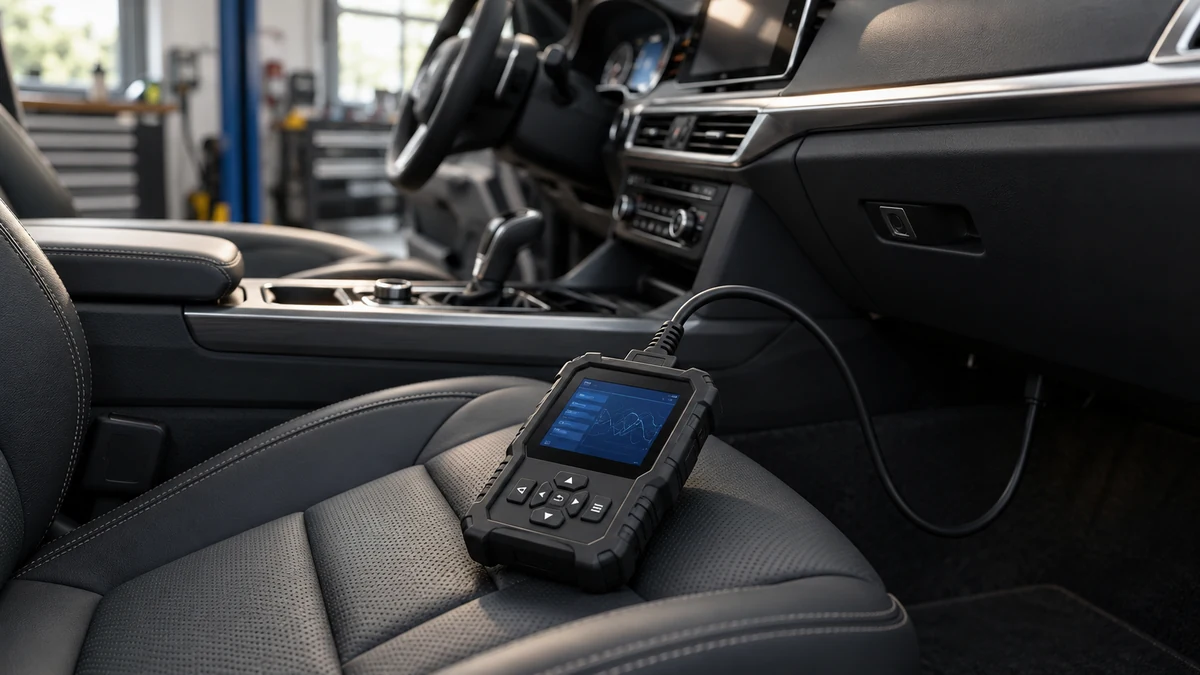
OBD code reference: selected fault codes
The most common codes, each with a detailed, editorially reviewed explanation.
Understanding OBD-II fault codes
What is an OBD-II fault code?
A diagnostic trouble code (DTC) is an entry recorded by the vehicle’s diagnostic system. It describes a detected condition in a monitored system, helping to narrow down further investigation. A code alone is not evidence that a particular replacement part is needed.
How are OBD fault codes structured?
The format supported here contains five characters, such as P0420. The first letter identifies the vehicle system. The remaining characters identify the detected condition; they can include the letters A to F.
| P | Powertrain: engine and transmission |
|---|---|
| B | Body |
| C | Chassis |
| U | Communication between control modules |
Classification reference: Bosch OBD1150, section 3.6 (PDF).
What does P0420 mean?
P0420 describes catalyst system efficiency below the threshold on bank 1. The measurements used to assess it depend on the vehicle. The code calls for investigation of the system; it does not automatically justify replacing the catalytic converter. Read about P0420 in detail.
Example of monitor operation: Ford OBD-II System Operation Summary 2013, Catalyst Monitor (PDF).
What does an illuminated check engine light mean?
The light indicates that a fault has been detected; stored codes provide more specific clues. A steady light and a flashing light require different consideration. The light alone cannot identify a defective component or establish whether it is safe to continue driving. Follow the owner’s manual.
If a warning light flashes or the vehicle shakes severely or overheats, stop safely and seek qualified assistance. A general online explanation cannot assess the vehicle’s condition.
Background: EPA: OBD Frequently Asked Questions.
My tool shows P0420-00, 16804 or 2A82 – what does that mean?
Many scan tools and workshop systems display a code with a two-character suffix, such as P0420-1C or P042000. The suffix is the failure type byte and describes the kind of fault, for example “circuit open” or “signal plausibility failure” (assignment per ISO 15031-6 / SAE J2012-DA). The decoder separates the suffix, explains the five-character code and names the failure type.
Five-digit numbers such as 16804 come from VAG diagnostic systems (VCDS, ODIS). Within the 16384 to 18431 range they convert to generic P0 and P1 codes; 16804 corresponds to P0420. Smaller numbers such as 00575 are manufacturer-internal component codes without a generic equivalent.
Four-character hexadecimal codes such as 2A82 come from manufacturer systems (for example BMW). They are not OBD-II codes and need the manufacturer documentation. You can enter several codes in a row, for example “P0420 P0171”.
Can I read a fault code myself?
A compatible OBD scanner, or an adapter with diagnostic software, can read supported codes. Access to individual control modules depends on the vehicle and the equipment. This decoder explains codes you have already read; it does not connect to your car. Follow the vehicle and scanner instructions.
Do OBD codes mean the same thing for every manufacturer?
No. There are standardised and manufacturer-controlled ranges. P0 generally identifies a generic range; P1 identifies manufacturer-specific definitions. The allocation of other ranges also depends on the code family. Manufacturer-specific entries need documentation for the relevant vehicle.
Does a code identify the defective part directly?
No. An unexpected measurement can have several causes. Other codes, the circumstances, stored operating data and appropriate testing all contribute to a diagnosis. Lists in this decoder are possible starting points, not confirmed diagnoses or repair instructions.
What if my fault code cannot be found?
Check all five characters, including the difference between the digit 0 and the letter O. This database contains generic OBDex entries and does not cover every manufacturer diagnostic system. Keep the scanner’s complete readout and consult relevant manufacturer documentation or a qualified workshop if needed.
Data source
The decoder uses the open OBDex database in a reviewed copy hosted by FRALIMO. The lookup loads data from FRALIMO only: your input is not sent to any diagnostic service, and no search history is saved.
OBD-II code data: OBDex (CC0 1.0) · Revision a9d0220bdb99
How to read the results
The generic records do not provide comprehensive manufacturer diagnostics. Additional information has not been checked for every vehicle; missing, conflicting or overly generic information is flagged or omitted. Repair cost and repair time estimates are not displayed.
A fault code describes a detected condition and does not prove which component is defective. If a warning light flashes or the vehicle shakes severely or overheats, stop safely and seek qualified assistance.
FRALIMO does not provide vehicle diagnosis or repair services.
Understanding OBD-II live data
Besides fault codes, the interface delivers live measurements such as engine load, coolant temperature and fuel trim. The standardised parameters (PIDs) with unit, range and formula are listed in the live data reference.
Open the live data reference (PIDs)Find a vehicle type with German HSN/TSN codes
Use the codes on a German registration certificate to find a published vehicle-type entry and its available KBA registration count at the reference date.
Open HSN/TSN lookupFRALIMO – Chauffeur service in Frankfurt and Rhine-Main
FRALIMO coordinates chauffeur journeys in Frankfurt and the Rhine-Main region with its own Mercedes-Benz E-Class, S-Class and V-Class fleet. Your journey is arranged through personal coordination.
Explore our fleet